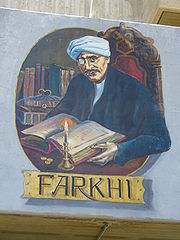
(1740-1818)
The Remarkable History of Pharchi.

(1740-1818)
The Remarkable History of Pharchi.
In the year 5560 (1800), there lived in Akko a distinguished, pious, and rich man, called Rabbi Hayim Pharchi, whose family belonged to Damascus. He was famous throughout the East not only on account of his great wealth, but also through his virtuous and generous course of life. He stood in high esteem at the imperial court of Constantinople; and the choice of all the Pachas in the whole of Syria depended on him. Whomsoever he proposed at court was appointed and installed, so that he might be considered in a measure as the ruler of all Syria. Nothing also was undertaken by the Sublime Porte in the East without first informing him of it. His house was the asylum for all the distressed and the sufferers of all nations and religions. Nothing but justice and equity could be executed in the whole land; because all the officers and authorities dreaded this just and excellent man too much to do anything wrong. In him the house of Israel in Palestine had, so to say, a pious and faithful regent, who protects his people in every possible manner, and bestows on them all kinds of benefits, and endeavours that all shall live happily under his sway. He knew nothing of oppression and exclusion, not to mention persecution. There lived also at the same time in Akko the tyrannical Pacha, Achmad Djizer, of whom I shall have to say more hereafter; he endeavoured to accuse the above noble philanthropist of treasonable devices: he accordingly had him arrested, and put out one of his eyes, and cut off the end of his nose. The court at Constantinople was informed of this terrible deed of infamy, but was not able to act against the tyrant, because it was feared that he would employ this as a pretext to organize a rebellion against the Sultan, and indeed there was ample evidence to make this intention a matter of certainty almost. But Achmad died soon after, and his place was conferred on Seliman Pacha. Pharchi had a distinguished Mahomedan friend, who died suddenly, with his wife, and left quite a young child, only a few years old, called Abdalla, who was without any protectors, and was therefore educated in the house of the noble Pharchi, who viewed him as his own child, and had him instructed in all the necessary scientific branches; and in addition to this, Pharchi caused that Abdalla was appointed Pacha of Akko, after the decease of Seliman. He at first viewed Pharchi as his father, and followed his guidance to execute justice and equity in the land. But as early as one year after assuming the government, he commenced to act counter to this advice and instruction, and was reproved occasionally on this account by his venerable guardian. Abdalla now observed that he stood in his way, and that he would be a check on the exercise of his mere will and pleasure, and resolved therefore to get rid of him. He endeavoured first secretly to accuse him of treason and other charges, to find thus an opportunity to lay violent hands on him. The confidants of Pharchi revealed to him the terrible purpose of his ungrateful ward, and advised him to save himself by flight. But he declined doing this, and he answered magnanimously that his flight would call down on all the Israelites of Palestine the greatest persecution, and might indeed cause their entire extermination, since the Pacha might be induced through his escaping, to wreak his fury on this innocent people. He added, that he was prepared for everything, and would bear patiently whatever might occur, in order to save thereby, or at least to benefit in some degree, his own people.
Now it happened, on Thursday, the 28th of Ab, 5579 (August, 1817), which the pious Pharchi kept as a fast day (as the eve of the New Moon of the month Elul), and as he was about to take his supper, that an officer with his soldiers suddenly entered his apartment; his death-warrant was read to him, in which he was condemned on account of treason, and with the offence that his private Synagogue was built higher than the mosque of Akko, and several other diabolical charges and crimes; and this sentence was instantly executed.
The day following his house and court-yard were ransacked and plundered, and a large quantity of gold, money, silver, and other valuable articles were carried to the Pacha, the monster and parricide. The corpse of this martyr he did not even permit to be interred, but ordered it to be cast into the sea; and when, the day following, it was carried again on shore, he ordered it to be taken out far into the sea, and then to be thrown into the water. The pious widow of Pharchi fled in all haste towards Damascus, but died suddenly on the road, and was buried in Zafed; and suspicion was entertained that she had been poisoned by the furies who surrounded the Pacha.
This deed of terror excited universal consternation and mortal fear in all Palestine, especially among the Israelites; and the parricide now showed himself openly as the persecutor of the Jews in the Holy Land, and exercised such acts of violence and abomination among them, as are not perpetrated by cannibals and savages. My friend S. M., who lives at present in Jerusalem, was at that time an active and courageous young man, who often went to Akko as dragoman, that is, interpreter, with commissions from the Russian Jewish congregation of Zafed, and in consequence came frequently to the house of the consul. A few days after the above tragical occurrence, he had to attend to some business for the congregation, and therefore visited Akko, and the consulís house among others. All at once, Abdalla came in, and was received very friendly by the consul, who was his bosom friend from early youth, as both had been at the same time brought up by the same nurse. They went together into a side room, and had a confidential conversation. S. M. perceived that something very important was being discussed between them, and had the courage to approach softly and to overhear them. The substance of what reached him was, that the Pacha requested his faithful foster�brother not to interfere, in his consular capacity, with his own affairs; that he had no intention to touch the foreigners who were under the consulís protection; but that he desired of him not to put any obstacles in his way, in the manner he intended to proceed with the other Jews. The worthy consul had humanity enough not to refuse any favour to his brother, and promised him faithfully not to make any representations whatever to him in this respect, notwithstanding his great influence. The Pacha then continued: ìI mean, on the coming Saturday, during divine worship, to surprise the Synagogue, and to hang up before the same, on the instant, the spiritual chief of the Jews, A. J. I intend, also, to proceed in the same manner at Zafed, to capture, during worship, the three richest among them (giving here their names), to hang them, and to confiscate their property. My friend S. M. having thus listened to this frightful conversation, moved quietly from the spot he had occupied. The Pacha soon after took his leave; S. M. of course did not give the consul the least cause to perceive that he had heard what was going on; he thereupon concluded his business, and then left him. But he hastened to the chief, A. J., and revealed to him in secret the danger in which he was, and advised him to escape on the instant by flight, without communicating the least to any one of the whole affair. The advice was followed; A. J. disappeared suddenly, and no one, not even his household and friends, knew what had become of him, or whither he had gone. S. M. hastened next with equal speed to Zafed, and revealed the secret to the three proscribed rich men, who also disappeared suddenly in the same mysterious manner, and no one could tell where they were. The Saturday at length came; no one knew anything of the fatal plan of the Pacha, and all assembled as usual in the Synagogue at Akko. Suddenly the troops made their appearance with a gallowsí frame before the Synagogue, and they entered to seize A. J., in order to hang him. But he was not there, and could not be found all over the town. The Pacha now commanded to seize another respected man in his stead; this was done, they beat him cruelly, and dragged him, though perfectly innocent, to the gallows, to hang him up. But the Pacha said he would pardon him, if he would become Mussulman, and confess the Koran. The other, in his fright, assented, and was thereupon liberated. But he afterwards fled the city, despising the Koran and the Prophet, and lived again as a faithful Jew.
In Zafed, also, the prior resolution of the Pacha was proceeded with; but the three rich men destined to be hanged had likewise disappeared, and could nowhere be found. He therefore ordered all the Jews of the place to be locked up in the castle, a small Kallai, and demanded of them an exorbitant ransom, which they were unable to furnish; so that they were compelled to sell even their garments, and whatever of value they possessed, in order to obtain their liberty. He also exacted much from the Jews in Tiberias and Akko. But Jerusalem and Hebron, being in the southern part of Palestine, belonged not to the Pachalik of Akko, but to that of Damascus, and the Jews residing there were spared for the present; they, however, had to endure since then other persecutions and exactions, when the monster at Damascus opened wide his fiery and deep jaws, and threatened to swallow up everything. Subsequently to the above related event, no one was secure in life and property in Galilee, on account of the tyrant Abdalla, till the excellent Austrian Jewish consul-general at Aleppo, the well-known Baron of Picciotto, employed the influence he had with him to restrain him in his barbarous procedure against his own brothers in faith.
In Damascus dwelt the three brothers of the martyr Pharchi; they were the most distinguished and honoured men of the whole surrounding country, not only through their wealth and their extensive commerce, which was carried on to all parts of the Orient, but also for their great influence in Constantinople and other large cities and towns, and they were likewise famed for their honest and noble conduct.* Their names were Seliman, Raphael, and the youngest Mosé Pharchi; the last mentioned died in 5600 (1840), through the torture inflicted by Serif Pacha, as one of the accused for the murder of Father Thomas, in which this excellent man was, among others, charged with having taken part in the slaughter of that old priest, to make use of his blood at the celebration of the Passover. When these men learned the deplorable death of their beloved brother, they resolved to be revenged on his murderer, even at the greatest sacrifices. Through their great influence at Constantinople they succeeded in obtaining a firman (a decree), signed by the Sheich al Aslam,Ü literally, the chief of the faith, authorizing them to take hostile measures against Abdalla. It was a small matter with them, on account of their immense wealth, to engage Seliman Pacha of Damascus, Mustapha Pacha of Aleppo, and two other minor Pachas, who were under the jurisdiction of these two principal ones, with their soldiers, to take the field against Abdalla. A large force having thus been collected, the expedition passed over the Jordan in the month of Nissan, 5581 (April, 1821). Abdalla marched out against the advancing Pachas; and a battle took place at the bridge over Jordan called Djisr abnÈ Yacob, in which he was defeated, and he fled in haste, retreating to Akko. The brothers Pharchi now took possession of all Galilee, deposed the officers appointed by Abdalla, and appointed others in their place. The victors next laid siege to Akko, where the famine rose to such a height, that a single egg was sold at 70 grush,á which at that time was near six dollars, and a sheep at 900 grush, or 78 dollars. The siege was continued for fourteen months, during which period the Pharchis supplied the place of the Pacha in the country, and acted as governors. But it was decreed that Abdalla should not yet meet his deserts, and he was permitted to have a few years more indulgence. He succeeded, through treachery, to have the worthy Seliman Pharchi poisoned, through which means he died suddenly in the month of Nissan, 5582 (April, 1822). Mustapha Pacha likewise showed, by his acts and conduct in battle, that he was not true to the cause in which he had embarked. Raphael Pharchi was therefore induced, shortly after the decease of his elder brother, to withdraw with Seliman Pacha to Damascus. Mustapha, it is true, maintained the siege till the month of Sivan (June), when he also withdrew to his own government.
• One who knew this excellent family maintained that this name Pharchi, ìthe Blooming,î from Perach, ìflower,î was quite appropriate, since among them was to be met with whatever was beautiful, great, noble, and religious, in the greatest flourishing state of development. Alas! that at present the flowers are nearly all fallen.
• This personage is the chief ecclesiastic of the Turks, on whose judgment and supervision of the whole ritual of the Moslems, all jurisprudence depended. The Sultan himself cannot alter his decision, and his signature is considered equal to that of the Emperor.
• The grush or piaster has no fixed exchange value; at present, it is 4 cents, 50 grush being 1 ducat, or 2 dollars ; some years ago, even as many as 60 were only worth a ducat. In old times, this term denoted a coin nearly in value a Spanish dollar, at another time the half of this, or 50 cents.
Abdalla saw himself thus freed from danger from that quarter, and had only now to fear the action of the Porte, and therefore requested Mahmud Ali, the Pacha of Egypt, to act as mediator between him and the Sultan. The Egyptian Pacha now employed all his influence to obtain the pardon of his compeer of Akko. The Sultan was greatly astonished to learn all the above proceedings, which were perfect news to him, since he had never been before informed of the tragical end of Pharchi of Akko, nor of the Damascus expedition against Abdalla, as the firman of the Sheich al Aslam was obtained without any knowledge on his part, and procured of the Divan (the council of ministers), through the great influence of the Pharchi and their very rich Saraf or court-agent, Rabbi Bechor Karmona. The Sultan was so incensed at this, that he banished the Sheich al Aslam from Constantinople, as he dared not to have him executed, but inflicted the punishment of death on the Saraf in the month of Tamuz, 5582 (July, 1822). But the greatest and the real crime which induced the sultan to this execution was, that the worthy Rabbi Bechor was too rich, and that he desired to appropriate to his own use the alleged criminal's great wealth. Abdalla was thus saved a second time; but instead of being grateful to Mahmud Ali, he subsequently commenced to defy him, till at length he was induced to besiege Akko in 5592 (1832), when he took Abdalla and carried him as prisoner to Egypt.
-------------------------------------------------------------------- ----
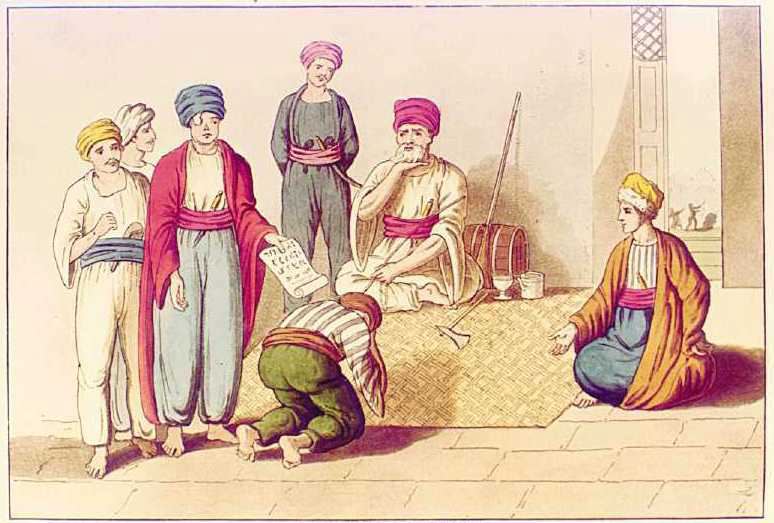
Haim Farhi, avec son œil crevé, son oreille et son nez coupés, tendant à Djezar Pacha, la condamnation d'un criminel (gravure anglaise effectuée d'après la relation du consul)
Drawn and Engraved by W. Stark after F.B. Pilsbury who traveled with Lady Stanhope to the Ottoman Empire
Published by G.S Treagar, 37 Union Row, New Kent Road, 1823.
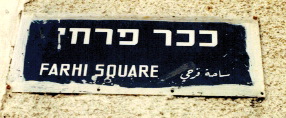
In today's Akko, Haim Farhi history and legacy has been finally acknowledged. A square has been named for him.

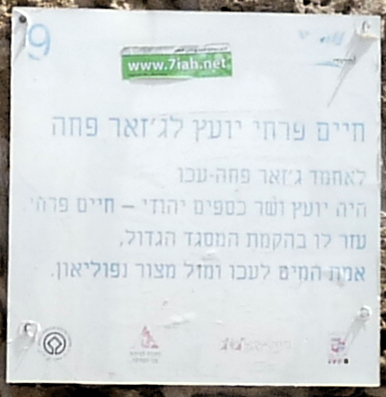
Plaques have been added to the house he once occupied.

At the museum of the Akko's fort and prison, a portrait of his has been shown as an older man.